
“And as he passed by, he saw a man blind from his birth. And his disciples asked him, saying, Rabbi, who did sin, this man, or his parents, that he should be born blind? Jesus answered, Neither did this man sin, nor his parents: but that the works of God should be made manifest in him. We must work the works of him that sent me, while it is day: the night comes, when no man can work. When I am in the world, I am the light of the world. When he had thus spoken, he spat on the ground, and made clay of the spittle, and anointed his eyes with the clay, and said unto him, Go, wash in the pool of Siloam (which is by interpretation, Sent). He went away therefore, and washed, and came seeing.” (John 9:1-7)
Consider Young’s Literal Translation of verses 3-4 without a full stop in between. In the originally written Greek scriptures there were no punctuation marks—no spaces between words. In Young’s Literal Translation (YLT) the sense reads as follows:
“...but that the works of God may be manifested in him; it behoves me to be working the works of Him that sent me while it is day”
A similar sense would be (I’m paraphrasing): ‘but that the works of God may be manifested in him, I (we) must work the works of Him that sent me while it is day’ [AV: ‘I’ ... RV: ‘we’] (John 9:3-4)
Why did Jesus perform so many miracles on the Sabbath day?
'“The Sabbath was made for man, and not man for the Sabbath: therefore the Son of Man is Lord also of the Sabbath” (Mark 2:27-28 AV)
And there is a far greater rest than the Sabbath: the rest that is found in Christ:
“Come unto me all ye that labour and are heavy laden and I will give you rest.” (Matthew 11:28 AV)
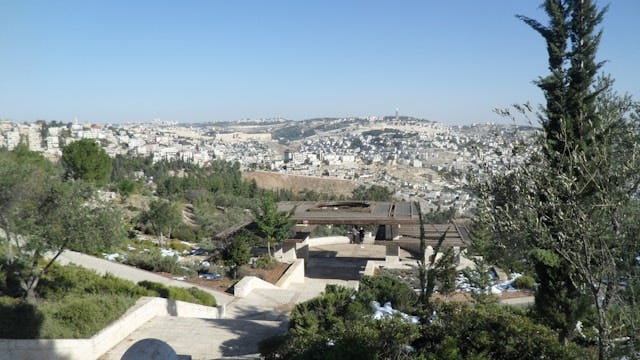
Apparently the use of saliva was a traditional ‘remedy’ for blindness. The Lord mixed his spittle with the dust of the ground—there may not have been anything out-of-the-ordinary about this situation to those looking on. However, this traditional ‘remedy’ in the Lord’s hands was transformative! Then the Lord says, “Go away to the pool of Siloam and wash.” We can picture the blind man eagerly, carefully, tapping his way with his staff, heading to Siloam. John specifically tells us the meaning of Siloam: ‘sent’. The water from the Gihon Spring was sent to the pool of Siloam—descending no more than 12 inches over the third of a mile length that it travelled. There would be a much steeper descent for the blind man who was sent from the temple mount down to Siloam but the Lord would not have sent him to Siloam if he wasn’t capable of getting there. No doubt he would have been well familiar with the route.
The waters were sent from the Gihon Spring. The blind man was sent from the temple mount.
In pointing out the meaning of Siloam as ‘sent’, John may be conveying to us the far greater descent from heaven, “The Father sent the Son to be the Saviour of the world.” (1 John 4:14)
Miracles, signs, works: these terms describe the same thing.
So the man, blind from birth, went away and washed in Siloam and came seeing. This was a great miracle, a unique miracle:
“Since the world began it was never heard that any one opened the eyes of a man born blind.” (John 9:32)
This miracle and the many miracles Jesus performed made known the glory of God and showed the deity of Christ. But though he had done so many miracles before them, they were not believing on him. (John 12:37)
Jesus said, “If I had not done among them the works which none other did, they had not had sin; but now they have both seen and hated both me and my Father.” (John 15:24)
Finally, John sums up his account of the miracles he’d witnessed:
“Many other signs therefore did Jesus in the presence of his disciples, which are not written in this book: but these are written, that you may believe that Jesus is the Christ, the Son of God; and that believing you may have life in his name.” (John 20:30-31)