
In 1971 the American astronaut James Irwin said,
Jesus walking on the earth is more important than man walking on the moon.
And one of our hymns says,
Down from his glory, ever living story,
My God and Saviour came, and Jesus was his name.
The great Creator became my Saviour,
And all God’s cruelness dwelleth in Him.
Last century - (sounds like a long time ago!) - before I was born, in late 1950, my dad’s mother said to him, “There’s a Mr Joe Lindsay holding special meetings in the Caledonia Hall in Greenock. Would you not like to go and hear him?” So he went along, and he said that he heard a preacher with a rich voice speaking about the Deity of Christ night after night. It’s no exaggeration to say that that was a turning point, a pivotal moment in my father’s spiritual life. Well, I only have half an hour tonight, and I’m not Joe Lindsay, but the Word of God is “living and active and sharper than any two-edged sword” (Hebrews 4:12). So in spite of my human failings, the Word of God still has the same dynamic power to inspire and awaken the hearts of those who are yearning for something more than the shallowness that this world can offer.
I’m going to read from several Bible translations tonight to illustrate my points, mainly the New King James Version and the English Standard Version, but also the NIV (New International) and the Revised Version.
Jesus walking on the earth is more important than man walking on the moon.
The deity of Christ is central to our understanding of everything in the Bible, but it’s a very sacred subject and we must approach it with reverence. We’re on safe ground if we confine ourselves to what God has revealed about Himself in His Word. The Bible describes God as a Trinity. Three distinct persons, yet essentially one. And that’s a concept that’s beyond our human minds to fully comprehend. For example, in Deuteronomy chapter 6 (v. 4) it says,
Hear, O Israel, the Lord our God, the Lord is one.
But the Apostle John writing to first century Christians said,
The Father has sent his Son to be the Saviour of the world. (1st John 4:14)
Father and Son, two distinct persons. And in John’s Gospel chapter 14, the Lord Jesus spoke of the Helper, the Comforter, the Holy Spirit, whom the Father will send in my name (John 14:26) He said, (in chapter 16):
It’s to your advantage that I go away, for if I do not go away, the helper will not come to you but if I depart, I will send him to you (John 16:7).
So the Lord Jesus, God the Son, tells us that both God the Father and God the Son would send God the Spirit. So here we have the three individual persons of the Godhead, the Holy Trinity, acting together as one. Then again in Matthew 3 (13-17), at the baptism of Jesus by John the Baptist, the Spirit of God descended from heaven in the form of a dove and rested on the Son of God, and the voice of God came out of heaven saying,
This is my beloved Son, in whom I am well pleased (Matthew 3:17).
So there’s the Trinity again. God the Father, the Holy Spirit, and God the Son. Three distinct persons, three eternal persons, three equal persons. The plurality of our Creator is clearly implied in Genesis chapter 1 (v. 26):
God said “let us make man in our image, according to our likeness.”
These are plural words, more than one. And in Matthew 28 (v. 19), the risen Christ commands his disciples to baptise converts into the name (singular ) of the Triune God:
Go therefore and make disciples of all the nations, baptising them into the name of the Father, and of the Son, and of the Holy Spirit.
Three separate, equal persons: Father, Son, and Holy Spirit. So, as I said, the reality of the Eternal Almighty God is far beyond the capacity of our finite minds to comprehend. So either we reject what we could never fully understand, or we take God at His word.
But it’s not simply a matter of blind faith. God has given us a mind with which we can weigh up the evidence that He has given us. So firstly, I want to look at four things in the Word of God that bear witness to the Deity of the Lord Jesus Christ. And secondly, I want very briefly to examine the eternal purpose for which the Son of God was sent. And lastly, thirdly, if the man who was put to death on a Roman cross two thousand years ago was God in human form, what should my response be to that unique event?
So firstly, let’s look at four things in Scripture which testify to the deity of the Lord Jesus.
First of all, the audible testimony of God the Father. Three times during the Lord’s public ministry, God spoke in an audible voice from heaven. twice to confirm the equal and eternal identity of the Lord, and once in response to his Son’s request. The first time it was at his baptism, as we’ve read already, a voice came from heaven, “This is my beloved Son, in whom I am well pleased” (Matthew 3:17).
The next time was on the Mount of Transfiguration, Matthew chapter 17, where The Lord had taken Peter, James, and John up into a high mountain, and he was transfigured before them. And then when Peter, as we know, said, let’s build an altar for Moses and Elijah as well, That voice came from heaven, the voice of God the Father: “This is my beloved Son, in whom I am well pleased. Listen to him.” Or, as Luke puts it, “a voice came out of the clouds saying, This is my Son, my chosen one. Listen to him.” (Matthew 17:5).
And then the third time that God spoke in an audible voice from heaven, in answer to a request from our Saviour in John chapter 12, the Lord said this - He said his soul was troubled.
And what shall I say, Father, save me from this hour? But for this purpose I have come to this hour. And then he said Father, glorify your name. He called God his Father. Then a voice came from heaven. I have glorified it, and I will glorify it again. (John 12:23-29).
The Lord Jesus spoke on such intimate terms with God, the Almighty God, he called him his Father, and God answered him. So three times God validated the sonship of the Lord Jesus Christ. He declared that Jesus is his Son. And by doing so he confirmed that Jesus was equal in status and by implication equal in authority to himself.
The second testimony I want to look at is the testimony of God through the inspired writings. The following statements were given by God to the Hebrew prophets, and they were endorsed by the Lord and by his disciples. In Isaiah chapter 9, it says, “For unto us” … - a well-known verse often quoted at Christmas time:
For unto us a child is born, unto us a son is given. And the government will be upon his shoulder, and his name will be called Wonderful Counsellor, Mighty God, Everlasting Father, Prince of Peace (Isaiah 9:6).
Then in Micah chapter 5 we read, (and this is what the Jewish religious people looked up when Herod asked where this child was to be born:
But you, Bethlehem Ephrathah, though you are little among the thousands of Judah, yet out of you shall come forth to me one that is to be ruler in Israel. whose goings forth are from of old, from everlasting (Micah 5:2).
So He’s an eternal person. And the angel Gabriel said to Mary in Luke chapter 1,
The Holy Spirit shall come upon you, and the power of the Most High shall overshadow you. Therefore, wherefore also that which is to be born shall be called holy, the Son of God (Luke 1:34).
There is the Triune God again, God the Holy Spirit - the Most High God shall overshadow you, the Holy Spirit shall come upon you and that which is to be born shall be called holy, the Son of God. So the Triune God acted in divine unity to bring about the miraculous virgin birth of the Lord of Glory. The child that was born to Mary in Bethlehem, (the Hebrew for Beth-lechem literally means the house of bread) - the child that was born in Bethlehem was none other than the mighty God, the everlasting Father, whose goings forth have been from of old from everlasting. And that’s why. He, when He was grown up, said to the Jews:
Before Abraham was, I AM (John 8:58).
He was the eternal God in a body of flesh and blood. And the writer to the Hebrews quotes from Psalm 45 in Hebrews 1 when he says,
“But to the Son he says “- that [is] God says to the Son:
“Your throne, O God. Is forever and ever” (Hebrews 1:8)
God the Father speaking to God the Son about the eternal duration of his kingship and his absolute authority. In Colossians chapter 2, Paul writes this about the Lord Jesus. He says:
For in him, [in Christ] dwells all the fullness of the Godhead bodily (Colossians 2:9).
Writing to Titus in Titus chapter 2, he calls him
our great God and Saviour, Jesus Christ (Titus 2:13).
So both the old and the new sections of the Word of God clearly identify Jesus as God in human form. His name, as Isaiah said, was to be Immanuel, (God with us) - (Isaiah 7:14)
And then we come thirdly, to the testimony of the Lord Jesus Himself.
In John 5, Jesus said:
For the Father judges no one, but has given all judgment to the Son, that all may honour the Son just as they honour the Father. Whoever does not honour the Son does not honour the Father who sent him.
So Christ claimed that the intention of God the Father in giving all judgment, all authority, to the Son of God, is that all mankind should give equal honour to both the Son and the Father. Paul says exactly that in his letter to the church in Philippi He says in Philippians 2:
who being in the very nature God being in very nature God did not consider equality with God something to be used to his own advantage. Rather, he made himself nothing (John 5:22-23).
Equality with God. Now I want to read a slightly longer passage from John chapter 10 to underline what Jesus said about himself, and to look at the meaning that his Jewish contemporaries took from what he said. So we’ll go to John 10, starting at verse 22.
Now it was the Feast of Dedication in Jerusalem and it was winter. And Jesus walked in the temple in Solomon’s porch. Then the Jews surrounded him and said to him, How long do you keep us in doubt? If you are the Christ, tell us plainly. Jesus answered them, I told you, and you do not believe. The works that I do in my Father’s name they bear witness of me. But you do not believe, because you are not of my sheep, as I said to you. My sheep hear my voice, and I know them, and they follow me, and I give them eternal life, and they shall never perish, neither shall any one snatch them out of my hand. My Father who has given them to me is greater than all, and no one is able to snatch them out of my Father’s hand. I and the Father are one. Then the Jews took up stones again to stone him. Jesus answered them, Many good works I have shown you from my Father for which of those works did ye stone me? The Jews answered him, saying, For a good work we do not stone you, but for blasphemy, and because you being a man, make yourself God. Jesus answered them, Is it not written in your law, I said you are gods? If he called them gods to whom the word of God came and the scripture cannot be broken Do you say of Him whom the Father sanctified and sent into the world you are blaspheming, because I said I am the Son of God? If I do not do the works of my Father, do not believe me but if I do, though you do not believe me, believe the works, that you may know and believe that the Father is in me, and I in him (John 10:22-38).
So the question the Jews asked was, if you’re the Christ, tell us plainly. The Jews were waiting for the Messiah foretold in the Old Testament scriptures. In Greek, the word for Messiah is Christ. In the original Hebrew, it’s Mashiach. It means the Anointed One. That is, the God appointed Saviour, the one in whom is vested divine authority, the person that God has appointed to establish the kingdom of God, the rule of God on earth. Jesus’ answer did not sit well with the religious leaders of the Jews, because he claimed that his miraculous works proved that he was indeed the Christ, their Messiah, and that God the Father had sent him. He couldn’t have made it any clearer. He said, I and my Father are one. The Jews did not misunderstand that statement. They took such violent exception to it that they took up stones to stone him to death. Because they said, you being a man, make yourself God. The Lord Jesus didn’t refute their accusation, no. He doubled down on his claim to deity. He said,
If I do not do not the works of my Father, do not believe me. But if I do, though you do not believe me, believe the works.
So he challenged them to explain away the evidence of his miracles as being anything other than proof of his deity. Believe the works, that you may know, and believe that the Father is in me and I in him.
So let us just very quickly skim (fourthly,) over some of the mighty works that he did. I’m not going to say much about them, I’m just going to list them. The testimony of the Lord’s miracles, and just some of them.
He turned water into well-aged good wine in a moment of time (John 2).
He anointed the eyes of a blind man with clay made from his spittle, and gave him 20:20 vision (John 9).
And the man who had been blind from birth said to the unbelieving Jewish leaders:
Never since the world began has it been heard that any one opened the eyes of a man born blind. If this man were not from God, he could do nothing. (John 9:32-33)
The Lord put his fingers in the ears of a deaf man and made him hear (Mark 7:33)- I’ve got hearing aids to help me hear better - But the Lord put his fingers in a stone-deaf man, fingers in his ears, and immediately the man could hear.
With one brief command, he immediately regenerated the flesh and sinews of a man who had a withered hand in the synagogue. (Matthew 12:9-13)
And on another day he multiplied five barley loaves and two small fish, and amply satisfied the hunger of five thousand men plus women and children (John 6:9). The poet summed up that miracle so well when he wrote:
‘Twas seed time when he blessed the bread,
And harvest when he brake.
(Anonymous)
And in the middle of a howling gale on the Sea of Galilee he commanded the wind and the waves, “Peace, be still “ and they obeyed. Immediately there was a great calm. (Mark 4:39).
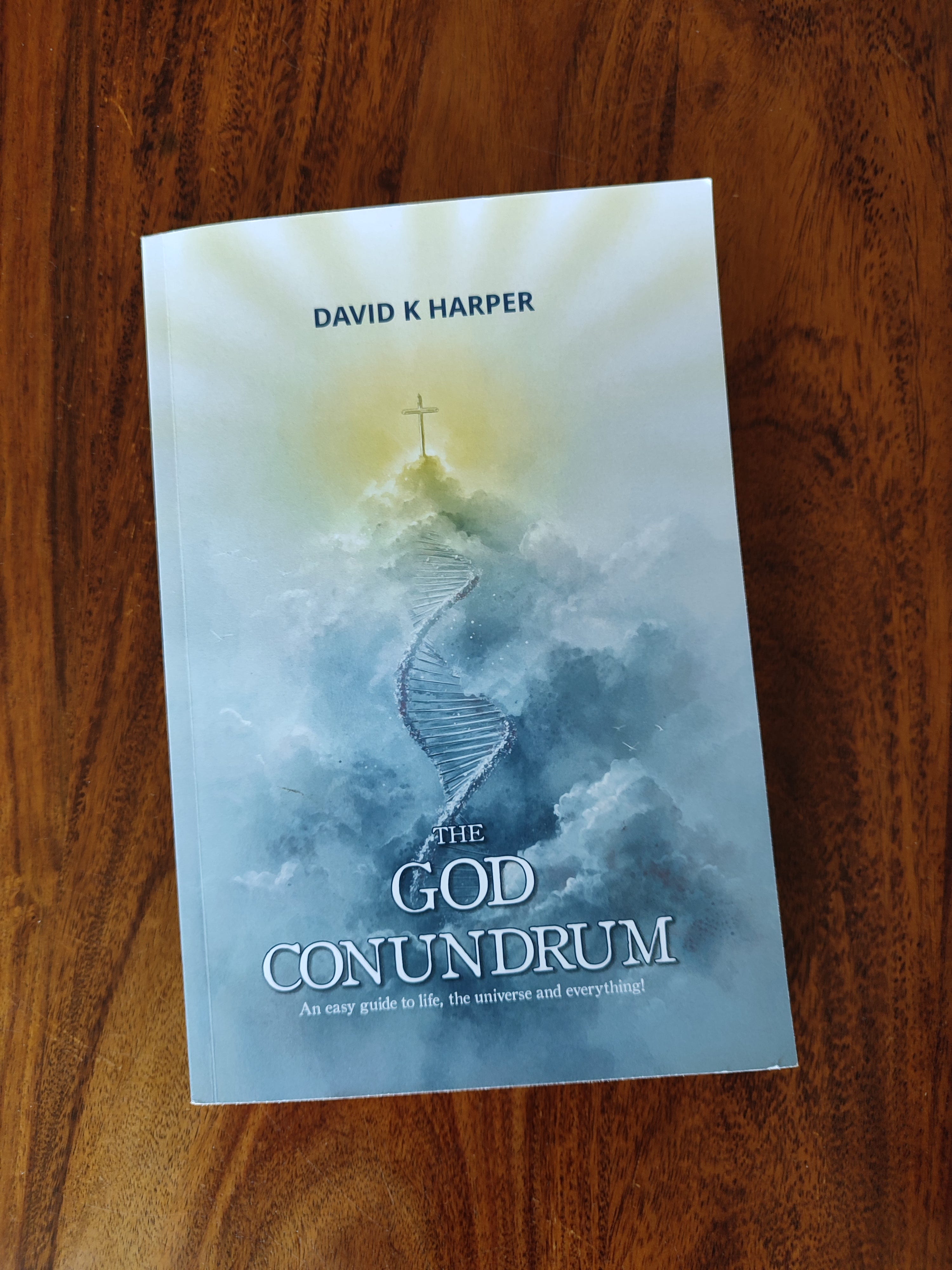
And you know, Jesus is the only one who can bring real and lasting peace to the troubled soul. Only recently we learned how antiques expert David Harper came to faith, because he witnessed the lasting transformation that faith in Jesus had made to his daughter Hattie, who suffered from severe depression for years. He’s just finished writing a book about his journey to faith - “The God Conundrum”, published a month or two ago. Well worth the read.
In the passage we just read in John 12, the Lord contemplated what lay ahead for him and it troubled his soul deeply. Yet he restated his commitment to the great redemptive purpose for which he had come. He said, “Truly, truly, I say to you, unless a grain of wheat falls into the earth and dies, it remains by itself alone, but if it dies, it bears much fruit” (John 12:24). And less than a week later, on the night of his betrayal in an upper room in Jerusalem, he took a loaf and he said This is my body, which is given for you (Luke 22:19). He took a jug of wine, he gave God thanks for it, and he poured it out into a cup. And passed it round his disciples with the words, This is the new covenant in my blood (Luke 22:20). Because on the cross, the very next day, He was going to be cut off out of the land of the living (Isaiah 53:8). And in that sense, He, the bread of life, was broken. He was cut off at thirty-three and a half years of age. As Son of God, he was and is an eternal, almighty being. As Son of Man, He was a young man in his prime. Great, profound mystery!
God the Father ensured that no bone of him was broken. Because he was the antitype, the fulfilment of the Passover Lamb, and no bone of that lamb was to be broken. God told Moses to instruct the Israelites in the land of Egypt. You’ll not break any of its bones, he said in Exodus 12. Because, in the words of John the Baptist, the last Jewish prophet, Jesus was the Lamb of God that takes away the sin of the world (John 1:29). There was no imperfection in the Lamb of God, nothing damaged about him. He was flawless, spotless, the sinless one. He was the sacrificial Lamb whose life was given so that you and I could be forgiven, so that we can be part of that tremendous harvest of souls that he has reaped, and will yet reap, through his death and triumphant resurrection.
So we’re talking about miracles. Apart from the miracle of the incarnation, when the Word who was with God in the beginning and who was God - became flesh (John 1:1-14), became a man - apart from that astounding event, there’s no greater miracle than the resurrection of Jesus Christ. And the fact that He raised people from the dead when He was here on earth is proof positive of His deity, for only God can raise the dead.
He raised a three-day old corpse, Lazarus, from the dead (John 11).
He raised the dead son of a widow from the village of Nain (Luke 7).
He raised Jairus’s twelve-year-old daughter (Luke 8).
Because, as he said to Lazarus’s sister Martha, he said:
I am the resurrection and the life. Whoever believes in me, though he die. yet shall he live, and every one who lives and believes in me shall never die. (John 11:24-25).
This is no mere man, dear friends no, no! This is the one who said:
I am the living bread that came down from heaven. If any one eats of this bread, he will live for ever. And the bread that I will give for the life of the world is my flesh. (John 6:50-51)
So his miracles are clear evidence of the supernatural, creatorial power of this unique person who was both God and man.
Secondly, I want to just ,very briefly, try and say something about the eternal purpose for which the Son of God was sent. Paul tells us in his letter to the Ephesian church, he said that we, disciples of the Lord Jesus, were
predestined, [or foreordained], according to the purpose of Him who works all things according to the counsel of His will so that we who were the first to hope in Christ, [that’s the Jewish followers of Christ he’s writing to] might be to the praise of his glory. [And then he says to the Ephesians, who were mainly Gentiles, he said:] In him you also were sealed with the promised Holy Spirit. Who is the guarantee of our inheritance until we acquire possession of it to the praise of His glory. (Ephesians 1:11).
So that’s the first part of God’s eternal purpose in sending His Son to die for sinners like you and me - it’s so that we could be an eternal witness to the love of God, so that we might be to the praise of His glory. The glory of our Saviour and our Creator.
And the second part of God’s purpose is found in chapter 3 of Ephesians. where the Apostle Paul talks about the plan of the mystery that was in accordance with the eternal purpose which He carried out in Christ Jesus our Lord, in whom we have boldness and confident access through faith in Him (Ephesians 3:11-12).
Boldness and access - To whom? and to what? To the thrice holy Triune God. To enjoy communion with our Creator, to be invited to have fellowship with God here on earth and in His eternal dwelling place. Because the letter to the Ephesian church is all about God’s intentional purchase of a people, a people who were redeemed, paid for, with the blood of the Lamb of God; a bride for his son, a people who will belong to him and enjoy fellowship and companionship with the Triune God forever. That’s a relationship that begins here on earth, and reaches into the ceaseless ages of eternity. (And I believe it’s what the Song of Songs is all about! )
Ultimately, the tabernacle of God, the house of God, the place where God lives will be with man. For we read about the new heaven and the new earth revealed to John, the Lord’s faithful disciple, when he was in exile for his faith on the Isle of Patmos in the Mediterranean, in Revelation chapter 21.
John writes:
And I heard a loud voice from heaven saying, “Behold, the tabernacle of God is with men, and He will dwell with them, and they shall be His people. God Himself will be with them and be their God. And God will wipe away every tear from their eyes; there shall be no more death, nor sorrow, nor crying. There shall be no more pain, for the former things have passed away’ (Revelation 21:3-4).
That’s the eternal purpose which God the Father carried out in Christ Jesus our Lord, so that we would be to the praise of his glory. So that we would live forever in communion and harmony, in fellowship with this generous, merciful, compassionate, thrice holy, all-loving God, the God of supreme love.
So lastly, what should my response be to the reality that Jesus Christ is God? Pontius Pilate, the Roman governor of Jerusalem, asked a vital question when the Jews called for the release of a terrorist murderer called Barabbas, instead of Jesus. Pilate said,
What shall I do then with Jesus who is called the Messiah? (Matthew 27:22).
And the Jewish leaders shouted out, Crucify him, crucify him! (John 19:6).
And Pilate was forced to make a decision about the innocent person who stood before him that day. We talked about it a little earlier. Every year, down through the centuries, in every observant Jewish household, a lamb was sacrificed. This was Passover time when Jesus was crucified. And that Lamb was to remind them that God had redeemed them from captivity in Egypt by the blood of a lamb. And countless lambs were offered on Jewish altars year after year, so that men could be forgiven their sins and draw near to the Holy God of Heaven who lived in their midst in the tabernacle and later on in the temple in Jerusalem.
And when John the Baptist saw Jesus coming to him to be baptized in the River Jordan He said, Behold the Lamb of God who takes away the sin of the world. He was talking about the anti-type of the Passover Lamb, and he was talking about the anti-type of thousands of lambs that were offered on Jewish altars. so that men could not only be redeemed, but also enjoy fellowship with God. The prophet Isaiah spoke of him in Isaiah 53:
He was oppressed and afflicted. Yet he did not open his mouth. He was led like a lamb to the slaughter, and as a sheep before its shearers is silent, so he did not open his mouth. (Isaiah 53:7-8)
That was the dignity of our Saviour.
By oppression and judgment, he was taken away. He was cut off from the land of the living. For the transgression of my people, he was punished. (Isaiah 53:7-8)
That’s what the Lord Jesus Christ did for you and me. As the writer to the Hebrews said, He tasted death for every one of us. so that sinners like me wouldn’t have to suffer eternal separation from the Triune God. This glorious person gave himself as an atoning sacrifice for my sins and yours, to redeem us, to bring us into a right relationship with God. That’s divine love, that’s love with a capital A! The Greek word for love, agape, means the highest form of love, the love which loves where there’s no love in return. On the cross of Christ, where Immanuel, (God with us), gave his life for my salvation. The cross of Christ is the evidence of such incomprehensible love. And the Lamb of God, in whom all the fulness of the multifaceted character of God dwells - the One who is meek and lowly in heart (Matthew 11:29), who allowed men to spit in His lovely face and hammer nails through his hands and his feet - He’s also the risen Lamb whom the Apostle John saw on the Isle of Patmos in his vision. In Revelation chapter 5 he says:
I saw a lamb standing [alive,] as though it had been slain (Revelation 5:6)
And in Acts chapter 17 (v. 31), it says:
He is the man whom God has ordained to judge the world in righteousness. By the man whom he has ordained. And he’s given assurance of this to all by raising him from the dead.
That was the words of Paul. But Pilate rejected him, condemned an innocent man to be crucified. One day the roles will be reversed. Christ will pronounce judgment on Pilate.
How should you and I respond to the reality that Jesus Christ is God, and that He died and rose again to bring such eternal blessing to me? Should we not be like Thomas, who when, eight days after the resurrection, the Lord showed him the nail prints in his hands and the spear wound in his side, Thomas simply said:
My Lord and my God (John 20:28).
I’m just going to finish by quoting the words of that well-known old camp hymn that we used to sing at Auchenfoyle. Probably still sing it! It calls us to a life of worship - A lifetime of worship!
King of my life, I crown thee now
Thine shall the glory be,
Lest I forget thy thorn crowned brow.
Lead me to Calvary.
Next address: FAITH