
My subject today is the authority of the Lord Jesus Christ - contrasted with the paradox - [ a paradox is an apparent contradiction ] - the authority of the Lord Jesus Christ contrasted with the paradox - of His infinite power and authority. - and His meekness and His patience and His grace, because, the person that we’re speaking about today is the one who was born in Bethlehem, was the master of the universe.
(In) Revelation chapter 1, John introduces Him as “the ruler of the kings of the earth.” That’s who he is.
And Jesus Christ has authority over Creation; over the powers of darkness; He has authority over sin and death; He has authority over all flesh; to Him every knee shall bow. His teaching when he was here on earth, was with authority, and His miracles demonstrated that authority.
And yet, in the face of extreme provocation, the man who is God displayed supernatural patience and gentleness and grace toward those who tormented Him. And he submitted Himself to the will of the triune God, to the great redemptive purpose of the ages: “the eternal purpose which God purposed in Christ Jesus our Lord,” as Paul says in Ephesians 3.
So, first of all,
His authority over the elements
The great Creator, when the storm arose on the Sea of Galilee … we’ll read about it just briefly in Mark chapter 4. We’ll turn to Mark chapter 4:39.
“And he awoke and rebuked the wind and said to the sea, Peace be still. And the wind ceased, and there was a great calm.”
The Lord was asleep in the stern of the boat, while this raging storm, the mountainous seas, threatened to overthrow the boat into the water. And I’ve been in a Force 10 gale between Aberdeen and Shetland and I can tell you it’s not a pleasant experience. These waves must have been similar, and that wind, that howling wind. And he stood up in the boat and he said,
“Peace, be still.”
He commanded the elements with one word and the whole thing calmed down in a moment, an instant of time. That’s His authority over the elements.
And yet when he was born into this world He submitted Himself to the weakness and vulnerability of a little child. He was dependent on His mother Mary for everything, totally dependent. And one of our hymns says,
‘He made the worlds by His great power, And none can stay His hand, or say, What doest thou? Thy wonders cease yet an infant babe He lay in Bethlehem’s manger on that day.’
It’s just amazing that the one who ‘upholds all things by the word of His power.’ That’s what it says in the scriptures. ‘He upholds all things by the word of his power’. And yet, this world hung on a slender thread, as it were, when he was born into this world as a little child.
And then in the prime of His manhood, at the age of thirty-three and a half or thereabouts, on the final day of His life’s journey to Golgotha, the man who is God, the one who has absolute power, and displayed that power over the raging elements, the sea and the wind - He submitted Himself in meekness to the rage of self-righteous, religious men, and to the unjust brutality of the Roman soldiers. The one who stopped the wind and the waves in a moment - He allowed puny, cruel men to nail Him to a cross and to subject Him to a storm of abuse.
They said ‘He saved others, himself he cannot save’. ‘Let him come down from the cross and we’ll believe on him’.
He could have come down. Why did he not? Why did he not deal with these insolent, profane men there and then? Because he had come ‘to fulfil all righteousness’. He had come to do the will of God. He had come to ‘restore that which he took not away’, the Bible says, to make atonement for sin. To ‘put away sin by the sacrifice of Himself’.
The Bible says we’re all sinners, you and I. Each one of us, we inherit original sin from Adam, our first parent. And God, in His mercy and grace, said, ‘I’m not going to destroy them. I’m going to send a Saviour to die and bear the punishment on their behalf.’ And he bore the wrath of God. The storm of God’s wrath was infinitely, infinitely greater than the rage of men and the storm on the Sea of Galilee.
Another hymn says, ‘That mighty stroke it fell on him, and life for us was won’. Only the man who is God had the power, the capability, the authority - ‘to put away sin by the sacrifice of Himself.’
He has authority over the spirit world.
When the devil took Him up to that high mountain and said - and showed Him ‘all the kingdoms of the world in a moment of time’ - He said to the Lord Jesus,
‘To you I will give all tHis authority. If you will fall down and worship me.” And the Lord refuted every temptation that the devil gave Him there. He said, “It is written, You shall worship the Lord your God, and Him only shall you serve.” The Devil was defeated. He had no answer, no comeback. He had more than met His match in the man who is God.
And that was still the case in the upper room on the night on which the Lord was betrayed. even as the cross loomed large. The Lord Jesus said, “The Prince of this world comes, and he has nothing in me.” That’s the Devil he was referring to: Satan, the arch-enemy of God. And yet, although, he had authority over the Devil and power over Satan, yet to the armed mob that Judas brought to the garden of Gethsemane that night, the Lord Jesus said, “This is your hour and the power of darkness.”
He acknowledged that the power of darkness was in the ascendancy over Him. He meant the Evil One who is behind all the spiritual darkness In this world, that causes men to do violent deeds to each other.
Jesus submitted Himself in meekness to those who embodied the power of darkness that night - because He had come to do the will of God. We were thinking this morning of how the Lord prayed that agonised prayer three times in the Garden of Gethsemane. “O my Father, if it be possible, let this cup pass away from me. Nevertheless, not my will, but yours be done.”
He submitted Himself to the cruelty of evil, wicked men who were motivated by the evil one. Because he had come to “fulfil all righteousness”, - “to put away sin by the sacrifice of himself”, to make it possible for guilty sinners to be forgiven and to come back to God, their Maker. Because it’s been well said before that there’s ‘a God-shaped hole’ in all our hearts, and “we’re restless until we find rest in Him”. That’s what Augustine said.
The authority of His teaching.
His teaching was “with authority”, the scripture says. It wasn’t like the teaching of the hypocritical scribes and Pharisees, who imposed overly strict codes of conduct and exempted themselves from the same obligations. The Lord said about them, He said, “All their works they do for to be seen of men”. And he said, “Woe unto you, scribes and Pharisees, hypocrites”. What a devastating indictment that was of their hypocrisy.
So he had authority even over those religious men that held power in Israel at that time. And yet even as he hung on the cross, he didn’t respond to their wicked insults when they challenged His deity.
Even as the man who is God hung bleeding from His hands and His feet, they shouted, “Come down from the cross and we’ll believe on you”. “He’s the Son of God. Let him now come down”. “He saved others. He cannot save himself. Let God deliver him if he delights in him,” they said. And that was a direct challenge to the unity of the Godhead, because if Jesus had come down - as he well could have - there would be no hope for you or me. We’d be lost for eternity to God. Lost forever. But he stayed there on the cross. That was supernatural discipline. It says in 1 Peter, “when he was reviled, he reviled not again”. Isaiah says, “As a lamb that is led to the slaughter, and as a sheep before its shearers is dumb, yea, he opened not his mouth.” That wasn’t weakness. That was strength. That was divine strength seen in His meekness. Because he had come “to seek and to save that which was lost,” - you and me.
He has authority over the effects of sin.
The miracles of healing that he performed, I’ll just refer to one of them. In Mark chapter 7, there was a man who was, what we would say, deaf and dumb, brought to Him. He put His fingers in his ears and he touched his tongue and he said, “Ephphatha” (in Aramaic) - “Be opened”. One word, “Ephphatha”, and immediately his tongue was loosed and he heard, he spoke plain. Because he wasn’t able to hear what people could say, and he could - in an instant - Jesus fixed the man’s disability.
And he has authority over death.
He said to Lazarus, who had been three days dead in the tomb, “Lazarus, come forth. And he that was dead came forth bound hand and foot with grave clothes.”
And yet, the one who had power and authority over death, it says “he became obedient even unto death, yes, the death of the cross.” And he even told His own disciples before he went to the cross exactly what was going to happen. He knew exactly what lay ahead of Him. Let’s just read that in Mark 10, please. Turn over to Mark 10:32.
“And they were in the way, going up to Jerusalem, and Jesus was going before them, and they were amazed, and they that followed were afraid. And he took again the twelve and began to tell them the things that were to happen to him. Saying, Behold, we go up to Jerusalem, and the Son of Man shall be delivered unto the chief priests and the scribes, and they shall condemn him to death, and shall deliver him to the Gentiles. And they shall mock him, and shall spit upon him, and shall scourge him, and shall kill him and after three days he shall rise again.”
The man who was God was fully aware of what men were going to do to Him. He even said to Peter in the garden, when Peter took his sword to defend his Lord and cut off the ear of the high priest’s servant - I think he must have been aiming for the man’s head. The guy just got out of the way in time and it cut - the sword - cut his ear off. But the Lord said to him, to Peter, “put your sword back into its sheath. They that take the sword shall perish with the sword. Do you not know”, he said to Peter, “that even now I could call twelve legions of angels. But how should the scriptures be fulfilled that thus it must be?” He had come to “fulfil all righteousness”. To make it possible for His righteousness to be imputed to you and me when we put our trust in Him. That’s why he didn’t resist arrest that day.
And so he has authority over sin and death and hell.
And, by His atoning death and His victorious resurrection, the cross of Christ is the greatest event that ever took place in this world. Because it was there that God in Christ, God in the person of His Son, the man who is God, asserted divine authority over death and sin, and Satan and his evil angelic followers.
Because it says in Colossians 2 I just want to turn to that. It’s quite a striking word - Colossians 2. That’s Ephesians, Philippians, Colossians 2:13.
“And you being dead,” this is Paul writing to believers in the Church of God in Colossae He says, “And you being dead through your trespasses and the uncircumcision of your flesh, you I say, did he,” (that’s the Lord Jesus), “did he quicken together with him, having forgiven us all our trespasses, having blotted out the bond written in ordinances that was against us. which was contrary to us”. (It was like a legal document against us.) “And he has taken it out of the way, nailing it to the cross. having put off from himself the principalities and the powers, he made a show of them openly, triumphing over them in it.”
So what that’s saying is that the Lord Jesus by His death on the cross triumphed over the powers of evil, the powers of Satan. And he “made a show of them openly.” And they have no comeback because their power is limited. And their day is coming, when he will judge them.
And so on the cross, as we were thinking again, as we remembered Him this morning, The Lord Jesus said, “It is finished”. The word teleo, which means complete. The atoning work of redemption was complete, and ‘he bowed His head and he gave up His spirit.’
John 17, please. John 17 and reading from verse 1. This is the prayer that the Lord Jesus made on the night on which he was betrayed. And this is just the start of His prayer to His God and Father. And he said these words.
“These things spoke Jesus, and lifting up his eyes to heaven, he said, Father, the hour is come. Glorify your Son, that the Son may glorify you. even as you gave him authority over all flesh, that whatsoever you have given him, to them he should give eternal life.”
Jesus Christ, the Son of God, has authority over all flesh.
And that means that because His sacrifice availed for all mankind - because he died for all, he took the sins of this guilty world, “for God so loved the world that he gave his only begotten Son, that whosoever,” - that means all - “whosoever believes in him should not perish but have eternal life.”
Because he died for all, then he has the right, the power, the authority, the legal, judicial entitlement to pronounce righteous judgment on all flesh. It says in John 1:12, “to as many as received him, to them gave he the right to become children of God, even to them that believe on his name.” So he has the right, the authority, to bestow eternal life on all those who believe on Him. And he also has the right to pass sentence, to judge those who reject Him.
“To as many as received him, to them gave he the right to become children of God, even to them that believe on his name.“
God and the Lord Jesus and the Holy Spirit, the triune God, have absolute authority over all things.
And that divine authority God has delegated to men. Men rise to positions of power and authority in this world, but that power and that authority is delegated authority, it’s limited. So when Pilate said to the Lord Jesus on that day when he was crucified, Pilate said, “Are you not speaking to me? Do you not know that I have authority? To release you and authority - power - to release you and power, to crucify you. That word power there is exousia, which means authority. Different from the word power dunamis - is power to heal.
“Do you not know that I have authority,” said Pilate to Jesus. “Over you?” Jesus said to him, “You would have no authority, no power over me, except it were given you from above.” And so the rulers of this world wield delegated authority, but they will answer to God for the way in which they have used that authority that God has given them.
What Pilate did not know was that the man who is God who stood before him that day had already surrendered His will, as we thought of what He said in the Garden of Gethsemane, “not my will but yours be done.” The Lord Jesus had already, in His mind and heart, given Himself for you and for me. There was no turning back for Him. No matter what it cost Him to go to the cross and bear the storm of God’s wrath against our sins. God took our sins and laid them on His beloved Son, that Holy One, and he was forsaken by God on the cross. And we will never know what it cost our Saviour to give His life for us. But he did it out of love. Out of grace and mercy toward each one.
We are ultimately accountable to His authority.
In Philippians 2 it says, “In the name of Jesus every knee shall bow”. One day you and I, and every person since Adam, will bow the knee whether willingly or unwillingly, we will bow the knee to Him, to His authority. And Paul writes in Romans 14 that “each one of us shall give account of himself to God”, quoting Isaiah 45.
So, my final question, which I want to ask of anyone who is not saved, who hears what I am saying today, “does Jesus Christ have the authority over your life?” Are you willing to surrender your heart to Him, to His authority? Are you willing to say, as the old hymn says, which we are going to sing in a minute:
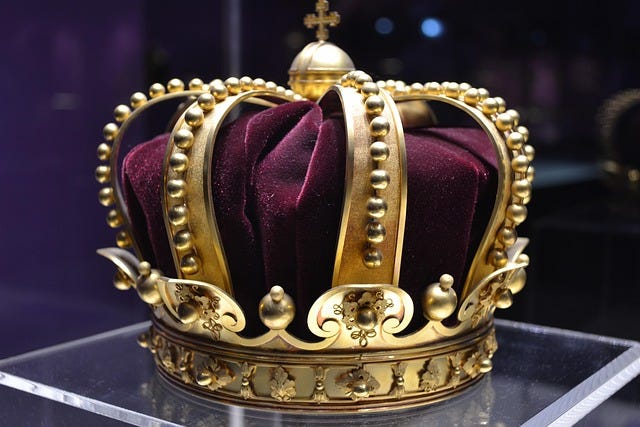
“King of my life, I crown You nowYours shall the glory beLest I forget Your thorn crowned browLead me to Calvary.“Will you bow to His authority now? Put your trust in Him, and let Him straighten out your life for time and for eternity,
We’ll just have a word of prayer before we sing our hymn.